


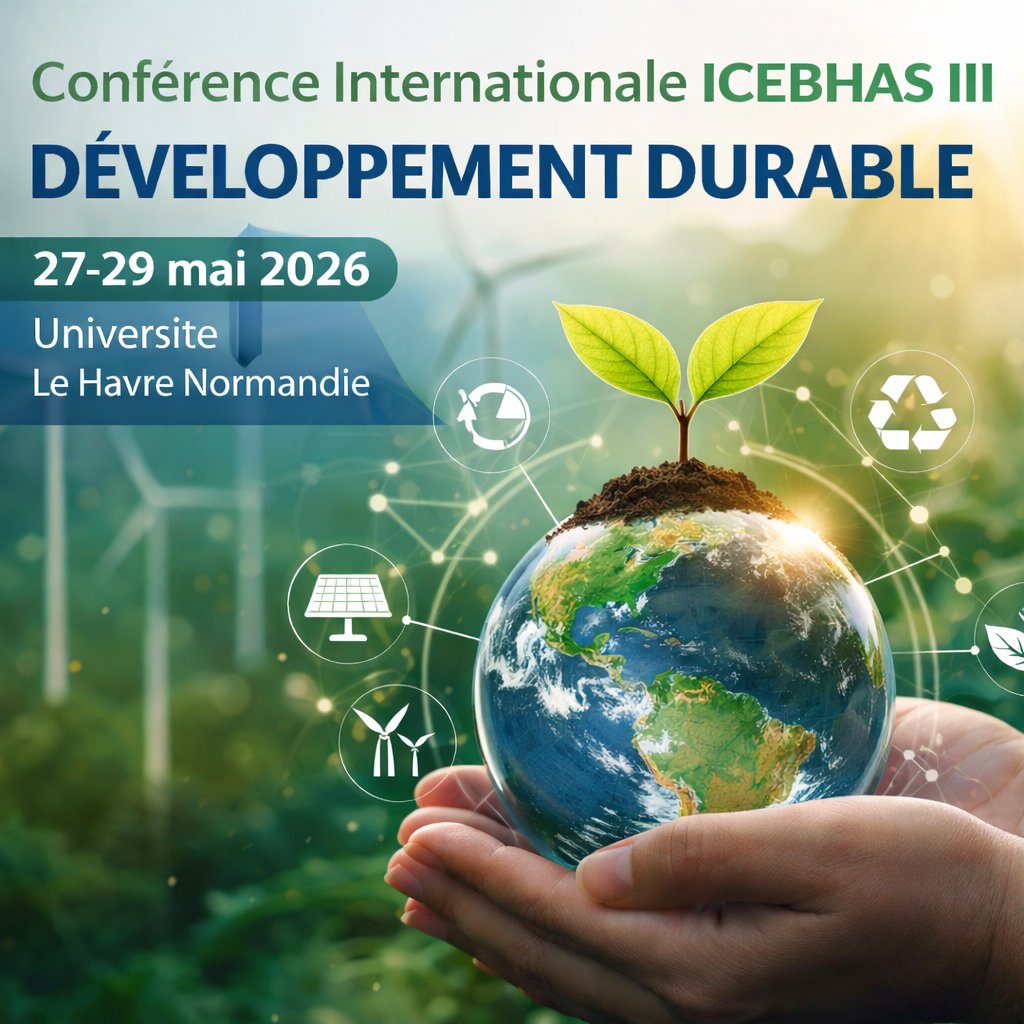
From wednesday, may 25 to friday, may 29, 2026, the research units EDEHN and NIMEC are organizing a conference entitled International Conference in Economics Business Humaniora and Applied Science.
This conference will highlight the following perspective : The interaction between economics, business, social science, education, and foresight within interdisciplinary studies offers a rich needlepoint for exploring and enhancing sustainable development. At its core, this integration seeks to leverage insights from multiple disciplines to better understand and predict future trends, thereby enabling more informed decision-making today. This approach is particularly relevant in sustainable development, where the need to balance economic growth with environmental preservation and social equity is dominant.
Thematic tracks
Track 1 – Game Theory and Strategic Interaction in Economics
Chair : Sylvain Baumann, University of Le Havre Normandy
Game theory provides a powerful framework for analyzing strategic interactions among rational agents in various economic contexts. From market competition and bargaining to auctions, public goods provision, and regulatory compliance, game-theoretic approaches illuminate how individual incentives shape collective outcomes.
This track welcomes contributions that use cooperative or non-cooperative game theory to address economic questions involving conflict, coordination, or negotiation. We encourage both theoretical and applied research.
Submissions may explore applications in industrial organization, labor and contract theory, environmental economics, public policy, or any other domain where strategic reasoning plays a key role. We particularly welcome work that connects formal modeling with empirical insights or behavioral considerations.
Track 2 – Spatial data analysis : methods and applications
Chair : Zouhair Ait Benhamou, University of Le Havre Normandy
This session invites contributions that employ spatial econometric methodsto explore economic or policy-related phenomena. The session seeks out submissions that make explicit use of spatial analysis — whether through spatial autocorrelation diagnostics, spatial regression models (SAR, SEM, SDM), spatial panel data techniques, or geographically weighted methods. The session is open to a broad range of applications, including but not limited to: local inequalities and spatial spillovers, real estate and housing markets, environmental and climate policy impacts, urban and rural labour market dynamics, innovation diffusion and industrial clustering, health, infrastructure, and public service access, and cliometrics analysis.
Both theoretical advancements and empirical applications are welcome. Submissions should clearly demonstrate the spatial structure of the data and the econometric strategy used to account for spatial dependence or heterogeneity.
Track 3 – Uncertainty and Risk in Economics
Chair : Nicolas Himounet, University of Le Havre Normandy
Uncertainty and risk are playing an increasingly important role in economic analysis and decision-making. In a global context marked by geopolitical tensions, climate change, financial volatility, and shifting policy environments, these factors profoundly influence economic activity, market behaviour, and public policy choices. Understanding how uncertainty affects investment, consumption, debt sustainability, and financial stability has become essential for building resilient economies.
This track welcomes contributions that examine the sources, impacts, and management of uncertainty and risk in economics. We are interested in theoretical, empirical, and applied research that sheds light on these dynamics.
Track 4 – Natural Resources, Economic Development and the Carbon Constraint
Chair : Yassine Kirat, University of Le Havre Normandy
The role of natural resources in economic development continues to generate intense academic and policy debate. While resource-rich countries often benefit from significant export revenues, their trajectories are frequently marked by macroeconomic volatility, institutional fragility, and limited structural transformation — a phenomenon widely referred to as the resource curse. More recently, the environmental implications of resource extraction have brought to light a complementary concept: the carbon curse, whereby reliance on fossil resource rents correlates with higher CO₂ emissions and delayed adoption of low-carbon technologies.
This track invites contributions that critically examine the complex relationship between natural resource endowments, economic performance, and environmental outcomes. Particular attention will be given to research exploring the mechanisms through which resource wealth can hinder or promote inclusive growth and environmental sustainability, especially in the context of the global energy transition and rising climate constraints. We welcome theoretical, empirical, and methodological papers addressing, but not limited to, the following themes: The macroeconomic and institutional determinants of the resource curse, The link between natural resource dependence and carbon-intensive development paths, Trade openness, fossil exports, and carbon leakage, Fiscal policy, debt dynamics, and revenue management in resource-rich countries, ….
Track 5 – Green Finance Meets Web3 : Promises, Pitfalls, and Policy Frontiers
Chair : Cyril Filezac de l’Etang, University of Le Havre Normandy
The ecological transition demands massive reallocation of capital — but also new infrastructures to channel and track sustainable finance. Emerging digital financial technologies (from tokenised green bonds to regenerative finance protocols) promise to accelerate this shift.
Yet they also raise fundamental challenges: How can energy-intensive blockchain infrastructures align with climate goals?
This track welcomes papers and projects that interrogate the synergies and frictions between Web3 finance and ecological imperatives — from technical architectures to policy and governance frameworks. Contributions may explore, for example, the carbon footprint of financial protocols, environmental token standards, or critical perspectives on the “greenwashing” of digital finance.
Track 6 – Strategic Materials: Economic, Political and Institutional Challenges of Their Governance
Chairs : Côme Lorgerie, University of Le Havre Normandy and Sandrine Lardic, University of Le Havre Normandy
This track invites economists to engage with the pressing challenges surrounding energy security and access to strategic materials in the context of the ecological transition. It aims to analyze the economic consequences of the geographic concentration of extraction and refining of critical resources, as well as the vulnerabilities created by price volatility and pressure on supply chains.
Contributions may explore the role of economic policy instruments in efforts to strengthen strategic autonomy. Particular attention will be given to how material constraints are integrated into energy planning models, the redistributive effects of resource security policies, and shifts in global energy markets that may influence the economic value of these materials. The track also opens space for reflection on governance models capable of aligning industrial sovereignty, energy resilience, and economic efficiency.
Track 7 – Rare Earths and Mineral Intensity : Exploring the Technological Futures of the Green Transition
Chairs : Sonia Bielewicz, University of Le Havre Normandy and Sandrine Lardic, University of Le Havre Normandy
Rare earths are a strategic vector in the energy transition, due to their role in mineral-intensive technologies such as wind turbines and electric vehicles. The evolving demand for these critical elements calls for precise modeling that incorporates both industrial dynamics and technological innovations that could alter their trajectories.
In this s6ession, contributions will focus on the following issues: What role does innovation play in the dynamics of mineral demand models? What types of innovations are the subject of patent applications in the field of rare earths, particularly regarding recycling or substitution? Can geographic or sectoral trends be identified in intellectual property strategies related to these materials? How do patents influence mineral demand models, especially when they lock access to certain processing or extraction technologies? To what extent can patents accelerate or hinder the diffusion of sustainable solutions within industrial value chains?
Track 8 – Sustainable Food Systems
Chairs : Sonia Aissaoui, Université Caen Normandie, Roland Condor, EM Normandie (English)
Food systems are undergoing major transformations to address environmental, social, and economic sustainability challenges. These adaptations affect all actors from producers adapting their farming practices, to processors, logistics providers, distributors, and consumers adopting more responsible behaviors. However, public directives, progress reports, and innovations vary from country to country depending on policy frameworks, technological innovation, and stakeholder involvement. The « Sustainable Food Systems » track aims to bring together researchers to discuss sustainable practices, the difficulties encountered in transforming food systems, explore emerging challenges, and share insight from diverse food systems. The objective is to encourage interdisciplinary dialogue and contribute to a better understanding of the transition toward more sustainable food systems.
Track 9 – Sustainable Urban and Rural Logistics : Planning and Experimenting for a Greener Future
Chairs : Claire Capo, Aix-Marseille Université, Kanyarat Nimtrakool, Chulalongkorn University, Bangkok, Thailand, Samuel Grandval, Université Le Havre Normandie (English-French).
This track invites researchers and practitioners to share their work on sustainable logistics across urban and rural contexts. We are looking for contributions that deliver real logistics management insights, optimize goods distribution, and offer strategic value within sustainability-focused frameworks.
We welcome research that supports sustainable development, boosts the attractiveness of territories, and engages with diverse territorial contexts. A strong emphasis will be placed on real-world experimentation and case studies, especially those reflecting a variety of territories and countries.
Track 10 – Low-tech in France : Emergence of a Network and Multiplicity of Actors
Chairs : Nicolas Praquin, Université Rouen Normandie, Olivier Desplebin, Université Rouen Normandie. (French)
Low-tech has long been present in individual, community, artisanal, and micro-entrepreneurial practices. However, the profound transformation of our natural ecosystems and the increasing scarcity of fossil fuels have led to an awareness of the finite nature of our resources, gradually leading to a form of institutionalization of these practices through multiple actors and the emergence of low-tech networks. This workshop aims to understand how this institutionalization occurred, who the actors were, what the barriers and levers to its diffusion are, and what prospects low-tech offers in terms of socio-ecological transition, employment, territorial revitalization, the development of new skills, and, more broadly, social reorganization.
Track 11 – Low-tech networks around the world : convergences and divergences of practices
Chairs : Nicolas Praquin, Université Rouen Normandie, Olivier Desplebin, Université Rouen Normandie. (English)
Faced with ecosystem challenges and the increasing scarcity of fossil fuels, low-tech has begun to move beyond the confines of invisible individual or collective practices to take a place in institutional networks with the support of public policy stakeholders. This session aims to take stock of low-tech institutionalization practices around the world through the sharing of networking experiences, engaged discussions, and successful and failed attempts. This session is primarily open to stakeholders able to provide proposals with a meso-, macro-organizational, or territorial approach.
Track 12 – SDGs & Women’s Entrepreneurship
Chairs : Pascale Bueno Merino, EMLV Business School, De Vinci Higher Education, Marie-Hélène Duchemin, Université de Caen Normandie. (English)
The aim of this workshop is to analyze the role and the impacts of the Sustainable Development Goals (SDGs) on women’s entrepreneurship. More specifically, it will assess the extent to which the SDG Agenda (quality education, gender equality, affordable and clean energy, industry, innovation and infrastructure, good health and well-being, etc.) contributes to the growth and sustainability of women’s entrepreneurial activity, as well as to the stimulation of public or private policies to support this activity.
Track 13 – Reindustrialization and Managerial Dynamics : Issues, Practices and Perspectives
Chairs : Marie-Laure Baron, Université Le Havre Normandie, Sonia Frouffe, Université Le Havre Normandie, Nathan Gouin, Université Le Havre Normandie (English-French).
This session aims to improve the understanding of the conditions that enable successful reindustrialization dynamics, a goal actively pursued by Western governments. Proposals may address organizational forms and governance models supporting industrial revival; impacts on work, skills, and human resource management; the role of innovation management in ecological and digital transitions; as well as interactions between firms, territories, and public actors, and more….
Pour toute question ou demande d’information, n’hésitez pas à contacter par mail : sylvain.baumann@univ-lehavre.fr